Before the Frame: What Studio Visits Teach Collectors That Gallery Walls Never Will
There is a particular kind of silence that settles over a gallery. It is deliberate, curated, almost architectural in its precision. The lighting has been calibrated. The walls have been painted to a specific neutrality. The spacing between works has been measured not merely in inches but in psychological intention. Galleries are, by design, environments engineered to present art at its most resolved—stripped of context, elevated from origin, made to appear as though it arrived fully formed from some unreachable creative ether.
For many collectors, this is the only version of art they ever encounter. And while gallery presentations serve an undeniable function, they also obscure something essential: the human architecture behind the work itself.
Studio visits offer a fundamentally different kind of encounter—one that serious collectors, once they have experienced it, rarely abandon.
The Studio as Primary Document
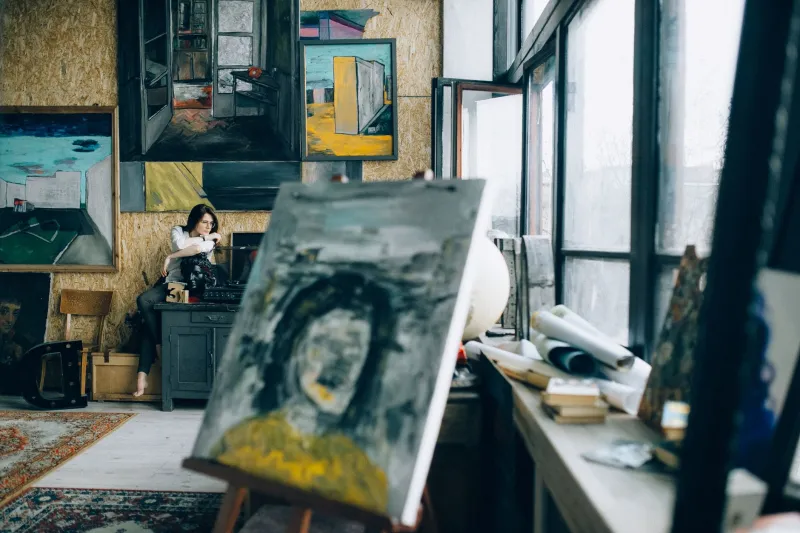
When you walk into a working artist's studio, you are not entering a showroom. You are entering a living record of creative thought. Unfinished canvases lean against walls in various stages of resolution. Reference materials—photographs, sketches, printed images, handwritten notes—occupy every available surface. The floor carries the evidence of decisions made and unmade. Paint-stained rags and discarded studies form an accidental archaeology of the artist's thinking.
This environment is, in its own right, a form of documentation. Collectors who engage with it develop an interpretive vocabulary that simply cannot be acquired elsewhere. They begin to understand not just what an artist made, but why, and perhaps more importantly, how—through what sequence of choices, reversals, and discoveries the finished work emerged.
For a collector, this knowledge is not merely sentimental. It is foundational to genuine connoisseurship.
What the Gallery Conceals
Galleries perform an essential act of translation. They take the raw, often chaotic energy of studio production and render it legible for a broad audience. That translation, however, comes at a cost. The friction of process—the false starts, the periods of uncertainty, the moments where the work almost became something else entirely—is edited out of the presentation.
Consider what a collector misses when they encounter a finished painting without that context. They see a resolved surface, a confident gesture, a composition that appears inevitable. What they cannot see is that the composition was, at one point, oriented vertically before the artist rotated the canvas. They cannot see the three previous color relationships that were painted over before the final palette emerged. They cannot see the two-week period during which the work sat untouched while the artist reconsidered the entire premise.
None of this is visible in the finished object. But all of it shapes what the object is. A collector who knows this history does not simply own a painting—they own a record of a particular kind of human struggle toward clarity. That distinction matters, both emotionally and, over time, in terms of how they communicate the work's significance to others.
The Sensory Dimension of Origin
There is also a purely sensory argument for studio visits that deserves acknowledgment. The smell of linseed oil, turpentine, and gesso. The physical scale of a work encountered before it has been stretched or framed. The sound of a brush moving across a surface, or the particular quality of light falling through a north-facing window onto a canvas in progress. These are not incidental details. They are the sensory grammar of the creative act, and they leave an impression on the collector that no gallery visit can replicate.
Psychologists who study memory formation have long understood that multisensory experiences create more durable and emotionally resonant memories than those processed through a single channel. A collector who has stood in the same space where a work was made, who has breathed the air of that environment and spoken directly with the artist about the decisions embedded in the piece, will carry a fundamentally different relationship to that work for the rest of their life.
This is not a trivial consideration. Collections that are built on genuine emotional connection tend to be more coherent, more purposeful, and ultimately more meaningful than those assembled primarily through market logic.
Conversation as Curatorial Intelligence
Perhaps the most undervalued aspect of the studio visit is the conversation it makes possible. In a gallery, the artist is typically absent. The collector engages with the work through the mediation of a dealer whose interests, however well-intentioned, are not identical to the collector's own. Information flows through an intermediary, and something is always lost in that transmission.
In the studio, the collector speaks directly with the person who made the work. Questions that would feel presumptuous or overly technical in a gallery context become entirely natural here. What were you thinking about when you began this series? How does this piece relate to the work you made three years ago? Where do you see this going? These are not merely polite inquiries—they are acts of curatorial intelligence, and the answers they yield shape the collector's understanding of not just individual works but the entire arc of an artist's development.
Collectors who cultivate ongoing studio relationships are, in effect, building a private archive of contextual knowledge. Over years, they accumulate a depth of understanding about an artist's practice that no catalog essay or gallery wall text can approximate. This knowledge informs every subsequent acquisition and sharpens the collector's ability to identify which works represent genuine turning points in an artist's evolution.
Intimacy and Long-Term Value
It would be reductive to frame the value of studio visits purely in financial terms, but it would also be intellectually dishonest to pretend that the intimacy of origin has no bearing on a work's long-term significance. Works acquired with deep contextual knowledge tend to be held longer, cared for more attentively, and situated more thoughtfully within a collection. They are less likely to be sold impulsively during market fluctuations precisely because the collector's relationship to them is not primarily transactional.
Furthermore, when works acquired through studio relationships eventually enter the secondary market or are donated to institutional collections, the provenance narrative they carry—one that includes direct collector engagement with the artist and a documented history of informed acquisition—adds a layer of significance that purely gallery-acquired works often lack.
An Invitation Worth Accepting
For collectors accustomed to the polished efficiency of gallery transactions, the studio visit can initially feel disorienting. It requires a different kind of attention, a willingness to sit with incompleteness, and an openness to information that does not arrive pre-packaged or pre-interpreted. It asks the collector to do some of the intellectual and emotional work themselves.
That work, however, is precisely what transforms a collection from an accumulation of objects into something more considered and more lasting. The gallery will always have its place. But the studio is where art is actually born—and collectors who have stood in that space, even once, tend to understand their collections differently ever after.