Growth or Compromise? Reading an Artist's Evolution with a Collector's Critical Eye
There is a moment familiar to most serious collectors: you return to an artist whose early work captivated you, only to find that their newer pieces feel somehow diminished—more polished, perhaps, but curiously hollow. The brushwork is confident, the palette refined, the compositions competent. And yet something essential has quietly departed. What you are witnessing, in many cases, is not growth. It is accommodation.
Distinguishing between these two trajectories is not merely an aesthetic exercise. For collectors who care about long-term relevance—about building holdings that retain meaning across decades—it is a practical imperative. An artist whose evolution is authentic will continue to generate work that rewards sustained attention. An artist whose development has been shaped by commercial pressure or collector expectation will produce work that satisfies in the short term and disappoints over time.
The Signature of Genuine Development
Authentic artistic evolution rarely announces itself. It tends to emerge gradually, sometimes awkwardly, as an artist works through ideas that are genuinely new to them. The work may become less immediately legible during periods of real growth—more searching, more willing to risk failure. This is one of the more counterintuitive signals available to a discerning collector: work that appears to be retreating in confidence is sometimes advancing in seriousness.
Consider what genuine evolution typically involves. The artist is grappling with something—a conceptual problem, a material limitation, a shift in philosophical orientation—that requires them to dismantle previous solutions. The resulting work may feel unresolved precisely because it is. This is not a flaw. It is evidence of an active intelligence refusing the comfort of repetition.
In contrast, work produced under commercial pressure tends toward resolution. It is neat, accessible, and reliably consistent with whatever the market has rewarded in the past. The artist has, consciously or otherwise, identified what sells and replicated it with increasing proficiency. The technical quality may actually improve during this phase, which is part of what makes the compromise so difficult to detect.
Warning Signs Worth Knowing
Certain patterns recur when an artist's trajectory bends toward the market rather than toward genuine inquiry. Collectors who recognize these signals early can make more informed decisions about where to direct their investment and attention.
Sudden accessibility. When an artist whose work has always demanded something of the viewer abruptly begins producing pieces that require no engagement whatsoever, the shift warrants scrutiny. Accessibility in itself is not a problem—but a rapid pivot toward the decorative or the immediately pleasing often reflects an external pressure rather than an internal evolution.
Repetition without development. There is a distinction between an artist who returns to recurring themes with deepening sophistication and one who simply reproduces successful compositions with minor variations. The former is building a body of work. The latter is manufacturing inventory.
Responsiveness to collector taste. Pay attention to whether an artist's work begins to mirror the aesthetic preferences of their primary buyers. This is subtle and not always conscious, but it is a meaningful signal. The artist who once challenged their audience and now consistently flatters it has undergone a significant transformation—one that rarely serves the long-term integrity of their practice.
Exhibition strategy that prioritizes volume over vision. Artists navigating genuine growth tend to be selective about when and where they show new work. Those operating under commercial pressure often exhibit frequently, flooding the market with work that has not been fully realized.
The Case of Artists Who Held the Line
History offers instructive examples of artists who faced considerable market pressure and refused, at real professional cost, to simplify or repeat themselves. Agnes Martin spent years working through a form of abstraction so refined and demanding that it alienated many collectors accustomed to more expressive work. Her refusal to accommodate the market's preference for the dramatic produced a body of work that has only deepened in critical and financial standing over time.
More recently, numerous mid-career artists working in the United States have navigated the tension between critical recognition and commercial viability by maintaining what might be called a private practice alongside their public-facing work—continuing to develop ideas that may not be immediately marketable while sustaining a commercial profile. This dual approach is not without its own complications, but it reflects a meaningful commitment to creative integrity.
What Collectors Can Do
The most reliable tool available to collectors evaluating an artist's trajectory is time. Resist the pressure to acquire work during moments of peak market enthusiasm and return to the artist's practice over a period of years. How does the work look after eighteen months? After three years? Does it continue to generate questions, or has it settled into comfortable familiarity?
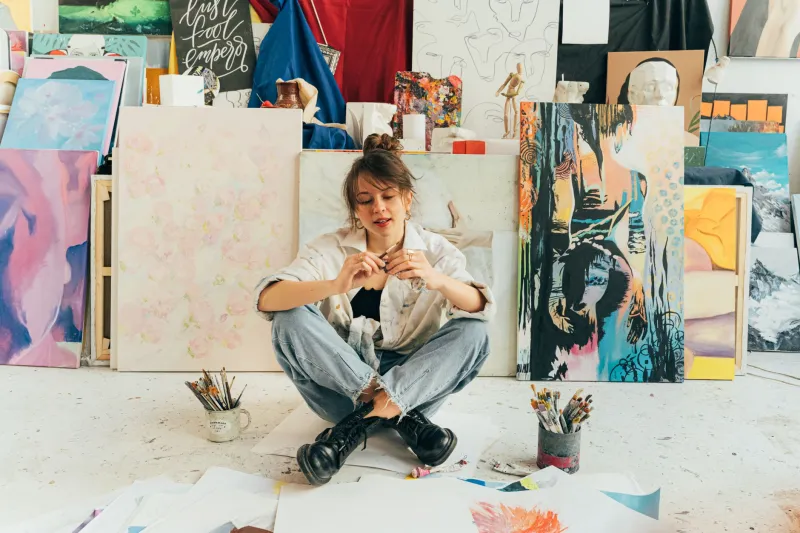
Studio visits, where possible, are invaluable. The work visible in a working studio—including abandoned pieces, experiments, and work in progress—reveals an artist's actual preoccupations far more honestly than a curated gallery presentation. An artist genuinely engaged in development will have evidence of that struggle visible in the studio. One operating on a commercial cycle will have something that looks more like a production environment.
Finally, pay attention to what an artist says about their own work over time. Artists who are genuinely evolving tend to speak about their practice with a quality of uncertainty—not because they lack conviction, but because they are genuinely working through ideas they have not yet resolved. Those who have settled into a commercial mode often speak with a fluency and confidence that, on closer examination, masks a lack of genuine inquiry.
The Long View
For collectors building holdings intended to endure—to appreciate in both financial and cultural terms—the distinction between authentic evolution and commercial accommodation is not a secondary concern. It is central to the entire enterprise.
Work produced from genuine creative necessity has a quality that persists across time and context. It continues to reward attention, to generate meaning, to resist easy categorization. Work produced to satisfy the market tends to date in ways that are difficult to predict but ultimately unmistakable.
The collector who learns to read these signals—who develops the patience and critical acuity to distinguish growth from capitulation—is not merely protecting a financial investment. They are contributing, in a meaningful way, to the ecosystem that makes serious artistic practice possible. That is a role worth taking seriously.