Against Coordination: Why the Most Compelling Collections Refuse to Match
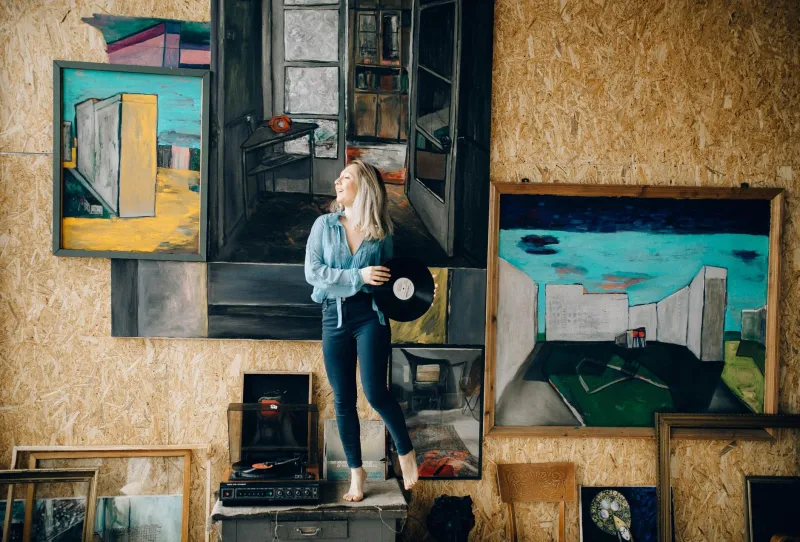
At some point in the life of almost every serious collector, an interior designer will suggest that a particular work is "too large" for a wall, or that two pieces "fight each other," or that a painting's palette "clashes" with the upholstery. This advice is usually well-intentioned. It is also, more often than not, precisely wrong.
The instinct to harmonize—to treat a collection as one element within a larger decorative scheme—reflects a fundamentally misaligned set of priorities. It positions the artwork as a component of a room rather than as the reason the room exists. For collectors who understand what original art actually does, this inversion is not a minor stylistic preference. It is a philosophical error.
The best collections I have encountered—not the most photographed, not the most frequently cited in shelter magazines, but the ones that genuinely stay with you—almost always contain something that breaks the room's internal logic. A work too raw for its surroundings. A scale that commands rather than accommodates. A pairing that creates friction rather than resolution. These are not accidents. They are the evidence of a collector who understands that art's job is not to complete a room but to complicate it.
The Decorator's Compromise
Interior design, at its core, is the art of coordination. It works toward resolution—toward spaces in which every element supports every other element, where the eye moves comfortably and the overall effect is one of considered wholeness. This is a legitimate and often beautiful ambition. But it is fundamentally at odds with what serious art collecting requires.
Original art—particularly work by living artists engaged with genuine ideas—is not designed to resolve. It is designed to open. A painting that functions as a resolved element within a decorating scheme has almost certainly been stripped of its most important qualities. The works that matter tend to assert themselves: they demand attention on their own terms, resist subordination to context, and create exactly the kind of productive dissonance that decorators are trained to eliminate.
This is not an argument for chaos. It is an argument for a different hierarchy. In a collection assembled around artistic conviction rather than aesthetic comfort, the works set the terms. The room responds to them, not the other way around. Furniture is selected for its neutrality as often as for its beauty. Walls are painted to recede. The collector's instinct about what a work needs—in terms of light, scale, and proximity to other works—takes precedence over any broader decorative program.
Scale as Argument
Few conventional decorating rules are violated more productively than those governing scale. The received wisdom—that large works require large rooms, that a painting should not overwhelm its wall, that scale should be proportional to the space—reflects a comfort-oriented logic that has nothing to do with how powerful art actually functions.
Consider the experience of encountering a monumental work in a modest domestic space. The compression creates intensity. The viewer cannot retreat to a comfortable viewing distance; they are implicated, absorbed, forced into a relationship with the work that a gallery setting might actually prevent. The discomfort is the point. Some of the most memorable works in private American collections occupy spaces that design professionals would describe as unsuitable, and their power derives precisely from that apparent mismatch.
Smaller works present a complementary case. A small, densely worked painting hung at eye level on an otherwise empty wall commands attention through concentration rather than scale. The conventional impulse to fill surrounding space—to "balance" the composition—dilutes exactly the quality that makes the work interesting. Sometimes a single work on a large wall is not a design failure. It is a statement of confidence.
The Productive Mismatch
Some of the most instructive collecting decisions involve deliberate juxtapositions that violate conventional curatorial logic. Works from different periods, different media, different scales, and different emotional registers placed in proximity can generate a conversation that neither work could sustain alone. This is not the same as random accumulation—it requires genuine understanding of what each work is doing and a considered judgment about what happens when they share space.
A collector in Chicago once described hanging a spare, almost monochromatic abstract work directly beside a densely figurative oil that was, in almost every formal respect, its opposite. The instinct was not decorative but argumentative: she wanted to see whether the contrast revealed something in each work that isolation had concealed. It did. The abstract piece became more structured in the presence of the figurative work; the figurative work became more atmospheric beside the abstract one. The pairing created a third experience that neither work offered independently.
This kind of thinking—treating the collection as a space for ongoing critical inquiry rather than a stable aesthetic arrangement—is incompatible with conventional decorating practice. It requires a willingness to live with productive discomfort, to resist the resolution that interior design promises, and to trust that the friction between works is generating something worth preserving.
When Raw Is Right
There is a particular kind of collecting that embraces not just formal tension but a certain roughness of presentation—works displayed in ways that expose rather than protect their material reality. Unframed canvases. Works hung on unpainted plaster. Pieces positioned at unconventional heights or angles. This approach is sometimes dismissed as affectation, but at its best it reflects a genuine understanding of what certain works require.
Some paintings are diminished by conventional framing. The frame signals completion, resolution, the work's status as a finished and bounded object. For works that are deliberately open-ended, that resist resolution as a matter of artistic principle, that framing can be a form of misrepresentation. Displaying such work without a frame—or with a frame that emphasizes rather than conceals the painting's material qualities—is not carelessness. It is fidelity to the work's actual character.
The same logic applies to installation height, wall color, and proximity to other objects. Every display decision is an interpretive act. The collector who makes those decisions with genuine attention to what the work is doing, rather than what the room requires, is practicing a form of curatorship that most interior designers are not equipped to offer.
The Collection as Argument
A collection assembled without reference to decorating conventions is, in the end, a collection assembled around conviction. It says something coherent—not necessarily comfortable, but coherent—about what the collector values, what they believe art is for, and what kind of experience they want their collection to create. That coherence is more durable, and more interesting, than any decorating scheme.
The rooms that stay with you are rarely the ones that match. They are the ones that make demands.