More Art Than Wall: The Collector's Guide to Managing a Collection That Has Outgrown Its Home
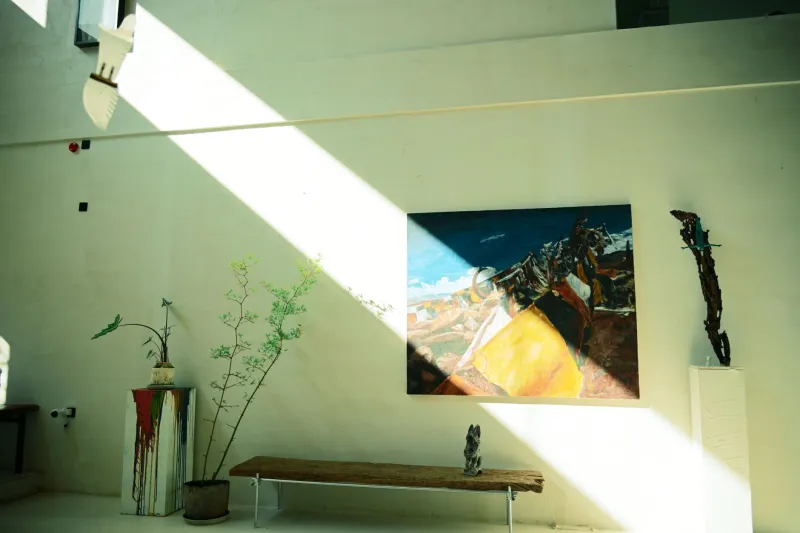
There is a particular kind of problem that only arrives after years of disciplined, passionate collecting: you have acquired more meaningful work than your home can reasonably display. The walls are spoken for. The storage is accumulating. And yet your eye continues to move forward, drawn toward new artists, new periods, new ideas that demand a place in your life. This is not a failure of judgment. It is, in fact, one of the clearest signs that a collection has reached genuine maturity.
But maturity brings its own demands. The collector who once hung everything they owned now faces decisions that are less about acquisition and more about stewardship—about how to live well with a body of work that has grown larger and more complex than any single room can contain.
The Difference Between a Working Collection and an Active Collection
Professional curators have long distinguished between the works that are on view and the works held in reserve. Serious private collectors would benefit from adopting a similar framework. The active collection is what you live with—the pieces currently on display, chosen for their resonance with your present aesthetic sensibility, the architecture of your home, and the emotional register you want your daily environment to sustain. The working collection is everything else: the acquisitions that remain in archival storage, the pieces that once held prominent positions and have since been rotated out, and the works you are still determining how to situate within the larger whole.
Thinking in these two registers removes a great deal of anxiety from the process. A painting in storage is not a painting that has been abandoned or diminished. It is a painting in reserve—awaiting the right moment, the right wall, the right chapter of your collecting life to come forward again.
Rotation as Curatorial Practice
The most sophisticated collectors treat their homes not as static galleries but as living exhibitions that evolve over time. Seasonal or annual rotation cycles allow a single domestic space to serve the breadth of a collection without forcing any single work into permanent competition with another.
Practically speaking, this means establishing a rhythm. Some collectors rotate on a fixed schedule—twice a year, aligned with the natural transitions of the calendar. Others rotate in response to emotional or intellectual cues: a new acquisition that demands prominent placement, a shift in personal circumstance, or simply the recognition that a particular piece has said what it needed to say in a given room and is ready to rest.
The physical logistics of rotation are worth taking seriously. Works in storage should be housed in climate-controlled conditions, properly wrapped, and catalogued with enough detail—dimensions, hanging hardware, provenance notes—that reinstallation is straightforward. In the United States, a number of fine art storage facilities catering specifically to private collectors have expanded significantly in recent years, offering white-glove handling and retrieval services that make rotation genuinely practical rather than merely theoretical.
The Psychology of Letting a Work Leave the Wall
For many collectors, the harder challenge is not logistical but emotional. There is something unsettling about removing a piece you once loved deeply and placing it in storage—a quiet suggestion, however irrational, that the relationship has cooled or that the work has somehow lost its claim on your attention.
This feeling is worth examining honestly, because it often reveals something important about how you understand your own collection. If a work can only retain its meaning for you while it occupies a visible position in your home, its hold on you may be more decorative than it is genuinely intellectual or emotional. The works that define a serious collection tend to retain their power regardless of where they physically reside. You know they exist. You know what they mean. Their presence in your life does not depend on daily visibility.
Cultivating this kind of relationship with your collection—one grounded in knowledge and conviction rather than constant proximity—is one of the quieter disciplines that separates collectors who accumulate from collectors who truly build.
Strategic Deaccessioning as a Tool for Clarity
Not every piece in a working collection deserves indefinite retention. Taste evolves. The works that once represented the leading edge of your aesthetic understanding may, over time, come to feel like artifacts of an earlier sensibility—meaningful in retrospect but no longer genuinely alive for you. Recognizing this honestly, and acting on it through thoughtful deaccessioning, is not a betrayal of your collection. It is a form of editorial rigor.
Deaccessioning can take several forms. Private sales through reputable dealers, consignment to auction, or direct placement with other collectors who share a genuine enthusiasm for a particular work are all legitimate paths. What matters is that the decision is made deliberately, with a clear understanding of both the work's market position and its place in your personal narrative as a collector.
The proceeds from a thoughtful deaccession can fund acquisitions that more precisely reflect where your eye has traveled—allowing the collection to sharpen rather than simply expand.
Rethinking the Space Itself
Sometimes the constraint is not the collection but the environment in which it lives. Before accepting that your walls are simply full, it is worth asking whether the architecture of your home has been fully considered as a curatorial resource. Hallways, stairwells, and transitional spaces that are often left bare can, with careful lighting and deliberate placement, become some of the most compelling areas in which to encounter art. A single strong work positioned at the end of a corridor, lit from above, can carry more visual weight than a crowded salon-style arrangement in a larger room.
For collectors who have reached the limits of their current residence, the question of space may eventually become a question about how they want to live more broadly—whether a studio, a dedicated viewing room, or even a more architecturally generous home might serve the collection and the life built around it.
The Collection as a Living Document
What distinguishes a serious collection from a well-decorated home is the sense that the works within it are in conversation—with one another, with the collector's evolving understanding, and with the broader history of art from which they emerge. That conversation does not require every work to be visible at once. It requires only that the collector remain genuinely engaged with the whole: returning to works in storage, reassessing relationships between pieces, and allowing the collection to breathe and shift as their own perspective deepens.
The wall, in other words, is only one venue for that conversation. The collection itself—its full scope, its contradictions, its unresolved questions—is the real exhibition. And unlike any gallery show, it has no closing date.