Seeing Past What You Already Know: The Perceptual Habits That Keep Collectors from Their Greatest Discoveries
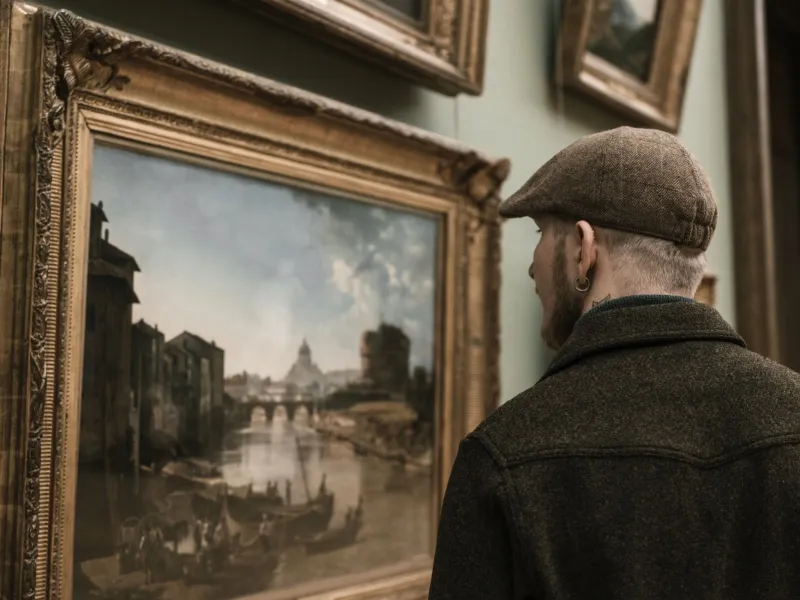
There is a particular kind of confidence that develops in a seasoned collector—the confidence of a trained eye. You have spent years refining your taste, learning to distinguish authentic ambition from decorative competence, and building a collection that reflects a coherent sensibility. That confidence is earned, and it is valuable. But it carries a shadow.
The same fluency that allows you to recognize quality quickly can also cause you to stop looking. You arrive at a fair, a gallery opening, or an artist's website with a set of expectations so well-developed that your attention moves almost automatically toward what already resembles what you admire. The work that does not immediately speak your visual language gets filtered out before you have truly considered it. This is not carelessness. It is, in fact, the natural consequence of expertise—and it is one of the most consequential blind spots in collecting.
The Psychology of Aesthetic Familiarity
Cognitive research has long documented the human preference for stimuli that feel recognizable. Psychologists refer to this as the mere exposure effect: we tend to evaluate things more favorably when they resemble what we have encountered before. For art collectors, this mechanism operates with particular force. A composition that echoes a beloved piece, a palette that recalls an artist you have followed for years, a scale that fits the logic of your existing collection—these features generate an immediate sense of rightness that can be mistaken for genuine aesthetic judgment.
The result is a collecting pattern that consolidates rather than expands. You acquire more of what you already have, not because the field offers nothing beyond it, but because your perceptual system is efficiently directing your attention toward familiar territory. The work that might challenge, surprise, or genuinely enlarge your vision is present—it is simply not registering.
This is the collector's blind spot: not an absence of opportunity, but an absence of attention.
The Structural Barriers That Reinforce the Pattern
Beyond individual psychology, the broader art market actively reinforces curatorial conservatism. The infrastructure of collecting—major galleries, art fairs, auction house highlights, institutional acquisitions, critical coverage in prominent publications—tends to concentrate visibility on artists who have already achieved a measure of recognition. The artist who has exhibited at a well-regarded Chelsea gallery, received a favorable review in a national publication, or entered a significant museum collection is the artist whose work surfaces reliably in the environments where collectors spend their time.
This is not a conspiracy; it is simply how attention and capital flow in any mature market. But it creates a structural bias that disadvantages less-visible practitioners, regardless of the quality or originality of their work. The artist working outside major metropolitan centers, exhibiting through regional galleries, building an audience through alternative channels—this practitioner may be producing some of the most compelling work available, yet remain genuinely invisible to collectors whose circuits do not intersect with theirs.
When familiarity bias and structural invisibility operate together, the effect is a collecting landscape that is far narrower than collectors typically recognize.
Practical Strategies for Expanding What You Can See
The good news is that perceptual habits, unlike matters of genuine taste, are responsive to deliberate intervention. The following approaches are not prescriptions for abandoning discernment; they are invitations to apply that discernment more broadly.
Deliberately enter unfamiliar spaces. If your collecting life is centered on a handful of established galleries and recurring art fairs, the diversity of what you encounter will inevitably be limited. Make it a practice to visit galleries operating outside your usual circuit—spaces in neighborhoods you do not typically frequent, university galleries, artist-run cooperatives, and regional exhibition venues. You are not obligating yourself to purchase; you are training your eye to process a wider range of visual propositions.
Sit with work that does not immediately appeal. The instinct to move on quickly from work that does not generate immediate enthusiasm is understandable, but it forecloses a significant category of potential discovery. Some of the most important collecting decisions collectors describe in retrospect were preceded by an extended period of discomfort or confusion. Give resistant work time. Return to it if you can. Ask what it is doing rather than whether you like it.
Engage with artists before engaging with their markets. The impulse to research an artist's exhibition history, auction results, and critical reception before forming an opinion about the work itself is a reliable way to substitute market consensus for your own perception. When possible, encounter the work first. Let your unmediated response form before you introduce the context that will inevitably shape it.
Seek out artists recommended by other artists. Established collectors tend to rely on gallerists, advisors, and peers for discovery. These are valuable networks, but they share certain biases. Artists themselves often have a more textured awareness of who is doing interesting work across different geographies and communities. If you have a relationship with an artist whose judgment you respect, ask them whose work they are watching. The answer will frequently point you somewhere your usual channels would not.
Audit your collection honestly. Periodically examine what you have acquired over the past several years and ask yourself what it reveals about the limits of your attention. Is there meaningful geographic diversity? Are there artists working in modes that genuinely challenge your existing preferences? If your collection tells a single, coherent story with few internal tensions, that coherence may be evidence not of exceptional taste but of exceptional consistency—which is not always the same thing.
What Expansion Actually Costs
It is worth being direct about what this kind of perceptual expansion requires. It does not require abandoning your standards or acquiring work you do not genuinely value. It requires accepting a greater degree of uncertainty in the early stages of encounter—tolerating the discomfort of not knowing immediately what to make of something, and resisting the efficient sorting mechanism that expertise provides.
This is, in its own way, a form of discipline. The collector who can hold open the question of whether a work matters—who can remain genuinely uncertain rather than defaulting to a quick negative judgment—is exercising a capacity that is rarer and more valuable than it appears.
The market for art by less-visible practitioners is also, it should be noted, structurally different from the market for established names. Acquisition prices are generally more accessible, competition from other collectors is lower, and the relationship with the artist tends to be more direct and more substantive. These are not trivial considerations for a collector building a collection with genuine long-term vision.
The Collection That Surprises Its Own Maker
The collections that endure—the ones that feel alive and irreducible rather than merely impressive—are almost always the ones that contain a few works the collector cannot fully explain. Pieces acquired on instinct, before the critical apparatus caught up. Artists discovered outside the established circuit, before the market confirmed what the collector already suspected.
Those discoveries do not happen by accident. They happen because the collector made a practice of looking beyond what they already knew how to see.
The work that will define the next chapter of your collection may already be in front of you. The question is whether you have trained yourself to notice it.