When the Collector Outgrows the Collection: Navigating Aesthetic Evolution Without Losing Your Way
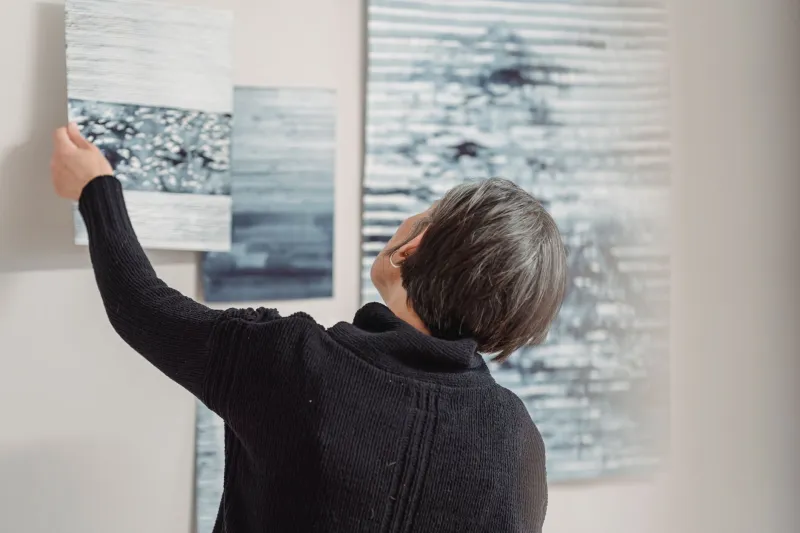
There is a particular kind of unease that visits serious collectors without warning. You walk through your own home—past works you once pursued with urgency, past pieces that once stopped you cold—and find yourself strangely unmoved. The acquisition that once felt like a revelation now registers as background. The artist whose vision once seemed indispensable now appears, in the cool light of accumulated experience, merely competent.
This is not a crisis. It is, in fact, one of the clearest signs that your eye has continued to develop. But it presents a challenge that few collecting guides address with adequate seriousness: what do you do when your taste has moved faster than your walls?
Growth or Instability? Learning to Tell the Difference
The first question worth sitting with is an honest one. Is the dissatisfaction you feel with earlier acquisitions the product of genuine connoisseurship—of a more refined, more demanding visual intelligence—or is it something more unsettled? Collectors who chase novelty for its own sake, who find themselves perpetually drawn to whatever is newest in the market, are not necessarily developing taste. They may simply be substituting stimulation for discernment.
True aesthetic evolution tends to be cumulative rather than cyclical. When your sensibility genuinely deepens, earlier works do not always become irrelevant; sometimes they reveal new dimensions precisely because you now have the vocabulary to read them differently. A painting acquired a decade ago for its surface energy may now disclose a structural intelligence you lacked the experience to appreciate at the time. That kind of re-seeing is among the most satisfying experiences collecting offers.
By contrast, if you find that your earlier acquisitions feel embarrassing rather than merely limited—if you are distancing yourself from them rather than reinterpreting them—it may be worth asking whether you are chasing taste as a social performance rather than following genuine aesthetic conviction. The distinction matters enormously, both for the integrity of a collection and for the financial decisions that accompany it.
The Architecture of a Collection That Can Absorb Change
Collections that endure tend to be built around a coherent sensibility rather than a fixed style. There is a meaningful difference between a collector whose holdings reflect a consistent set of values—a preference for works that reward sustained attention, for instance, or a commitment to artists who demonstrate rigorous conceptual development—and one whose collection simply mirrors the aesthetic fashions of successive decades.
If your collection has been built around genuine conviction rather than trend-chasing, it will almost certainly have the structural capacity to absorb new directions. A body of work organized around enduring principles can accommodate significant stylistic range. The collector who has always been drawn to works that operate through restraint, for example, may find that this sensibility leads naturally from one generation of artists to another, from one medium to an entirely different one, without any fundamental rupture in the collection's character.
The practical implication is that collectors who feel their taste has evolved should begin by articulating, as precisely as possible, what that evolution actually consists of. Is it a shift in medium—from painting to sculpture, or from traditional media to works on paper? Is it a deepening interest in a particular historical period or cultural tradition? Is it a growing preference for conceptual rigor over expressive immediacy, or the reverse? Naming the change with specificity transforms a vague restlessness into an actionable collecting thesis.
Adding New Directions Without Abandoning the Foundation
One of the most common mistakes collectors make when their taste shifts is to treat the new direction as a repudiation of the old one. This tends to produce two equally problematic outcomes: either a precipitous sell-off of earlier acquisitions that may later be regretted, or a kind of internal civil war within the collection, where new and old works coexist in unresolved tension rather than productive dialogue.
A more considered approach treats aesthetic evolution as an opportunity for expansion rather than replacement. Many of the most compelling private collections in the United States have grown precisely because their stewards allowed new enthusiasms to enter into conversation with established holdings rather than displacing them. The result is a collection that tells a story—not just about art, but about the development of a particular sensibility over time.
This does not mean that every earlier acquisition deserves to remain. There is no virtue in retaining work you have genuinely outgrown simply to avoid the appearance of inconsistency. But the decision to deaccession should be made deliberately, with a clear understanding of what the work meant within the collection's history and what its departure will signify. Selling from a position of reflection is categorically different from selling from a position of embarrassment.
When adding works that represent a new direction, it is worth considering how they will function spatially and conceptually alongside existing holdings. A new acquisition that seems to demand isolation—that refuses any relationship with what surrounds it—may be a sign that the new direction is not yet integrated into a coherent vision. Works that can hold their own while also entering into dialogue with their neighbors tend to signal that a collector's evolving taste has found genuine footing.
The Long View: Why Evolving Taste Is an Asset, Not a Liability
From the perspective of a collection's long-term significance, aesthetic evolution is not a problem to be managed but a dimension to be cultivated. Collections that reflect a single, unchanging sensibility can achieve a certain monumental coherence, but they rarely capture the full complexity of a collector's engagement with art over a lifetime. Collections that trace a genuine intellectual journey—that show where a collector began, how their thinking developed, and where sustained looking ultimately led them—tend to be far more interesting to future audiences, including institutions and scholars who may one day engage with the work.
For collectors who work with living artists, aesthetic evolution also creates opportunities that a static sensibility forecloses. An artist's practice rarely stands still; the collectors who stay engaged across the arc of a career often encounter work that surprises and challenges them in ways that early acquisitions did not. That willingness to be changed by what you see is, ultimately, what separates the serious collector from the accumulator.
The discomfort of feeling that your collection has not kept pace with your eye is not a verdict on your earlier judgment. It is an invitation to look more carefully, to articulate what you now know that you did not know before, and to build forward with the same conviction that built the foundation. The collection that grows with its collector is not a collection in disarray. It is a collection that is genuinely alive.