Substance Over Statement: How Collectors Can Tell Whether a Work's Ideas Actually Live in the Art
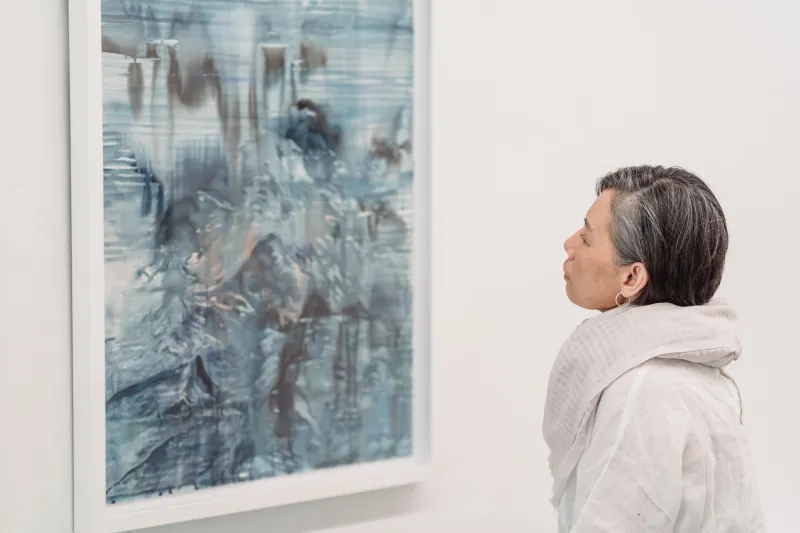
There is a particular moment that many experienced collectors will recognize. You are standing before a piece in a gallery or at a fair, and something feels slightly off—not wrong, exactly, but hollow in a way you cannot immediately name. The wall text is eloquent. The artist statement is ambitious. The gallerist speaks with conviction about the work's engagement with memory, trauma, systems of power, or the nature of perception itself. And yet the piece, when you look at it honestly, seems to recede rather than expand under that weight of language.
This is the depth illusion at work. And it costs collectors—both financially and aesthetically—more than most care to admit.
Why Sophisticated Language Can Obscure Rather Than Illuminate
The contemporary art world operates within an ecosystem that rewards articulation. Artists are expected to produce statements. Galleries must justify prices. Critics need frameworks. Auction houses craft narratives. The result is a culture in which the verbal architecture surrounding a work can become more developed, and more persuasive, than the work itself.
This is not a cynical observation—it is simply an honest one. Language is seductive in ways that visual experience is not. A well-constructed artist statement activates the intellect and provides a scaffold of meaning that makes engagement feel earned. The problem arises when collectors begin evaluating that scaffold rather than what it claims to support.
Work that merely performs sophistication tends to rely on this dynamic. It presents ideas that are genuinely interesting in the abstract—displacement, identity, the commodification of attention—while producing objects whose visual execution does not rise to meet those ideas. The statement becomes the artwork by proxy, and the actual piece functions as a kind of illustration of a more compelling concept that exists only in text.
The Critical Distinction: Ideas Embedded Versus Ideas Described
Genuine conceptual depth behaves differently. When a work has real intellectual substance, the ideas are not merely described by the accompanying text—they are present in the object itself. You encounter them through looking, through the experience of being in front of the piece, before you have read a single word of explanation.
Consider how this plays out in practice. A painting engaged with questions of visibility and erasure should make you feel that tension in the way paint is applied and removed, in the relationship between what is present and what is withheld. A sculpture exploring the weight of institutional authority should communicate something of that weight through its material choices, its scale, its relationship to the space it occupies. When these qualities are genuinely present, the artist statement functions as a deepening—it enriches what you have already begun to experience. When they are absent, the statement functions as a replacement.
This is the test worth applying: does reading the artist's statement cause you to return to the work and see more within it? Or does it simply cause you to feel better about what you have already seen?
Practical Frameworks for Evaluating Conceptual Integrity
Developing reliable instincts in this area requires practice, but there are several approaches that collectors have found genuinely useful.
Encounter the work before the text. Whenever circumstances allow, spend time with a piece before reading any accompanying material. Note your initial responses honestly—what draws your attention, what resists you, what produces genuine curiosity or discomfort. These unmediated reactions are data. If the work produces almost nothing before you have read about it, that absence is meaningful.
Assess the relationship between medium and meaning. Ask whether the artist's stated concerns are reflected in the actual decisions made in producing the work. An artist who speaks at length about fragility but works exclusively in methods that emphasize permanence and control may be describing aspirations rather than achievements. Material choices, scale, surface quality, and compositional logic should carry the conceptual freight the statement claims.
Look for specificity rather than breadth. Work with genuine depth tends to be specific in its concerns. It investigates a particular tension, a defined question, a precise visual problem. Work that performs sophistication often operates at a level of abstraction so broad that it could describe almost anything. Statements saturated with terms like interrogates, unpacks, or reimagines without specifying what, exactly, is being interrogated or reimagined are worth approaching with measured skepticism.
Seek the irreducible visual decision. Every work of lasting consequence contains at least one choice—of color, form, composition, material, scale—that could not have been made differently without fundamentally changing what the work is. Finding that decision and understanding why it matters is one of the most reliable indicators of genuine artistic intention. If you cannot locate such a decision, the work may be executing a formula rather than pursuing a vision.
The Market's Role in Amplifying the Problem
It would be incomplete to discuss this issue without acknowledging the role that market dynamics play in sustaining it. Prices generate legitimacy in the contemporary art world with a speed and efficiency that can be unsettling. A work that sells well at auction produces a narrative of significance that then feeds back into how subsequent works by the same artist are received and evaluated.
Collectors operating at the middle and upper tiers of the market are particularly vulnerable to this dynamic because the financial stakes create pressure to rationalize acquisitions. Paying a substantial sum for a work encourages a search for justification, and a compelling artist statement provides exactly that. The acquisition becomes evidence of discernment, and questioning the work's actual merit begins to feel like questioning one's own judgment.
The most effective defense against this dynamic is to develop evaluation criteria that are independent of price and institutional endorsement. What does the work do to you when you are in front of it? What does it continue to do after you have left? These questions are not anti-intellectual—they are the appropriate measure of whether conceptual ambition has been successfully translated into visual experience.
Collecting Toward Genuine Depth
None of this is to suggest that conceptual art is inherently suspect or that intellectual engagement is a liability in evaluating work. Quite the opposite. The most compelling collections are built around work that rewards sustained thought—pieces whose meanings unfold over years of living with them, that shift as your own understanding develops.
The distinction worth preserving is between work that invites genuine intellectual engagement and work that substitutes intellectual language for genuine experience. The former challenges you productively. The latter flatters you without delivering.
For collectors committed to building something of real consequence, the discipline required is not cynicism but clarity—a willingness to encounter work on its own terms, to sit with what it actually offers rather than what is claimed on its behalf, and to trust the quality of your own sustained attention as a measuring instrument.
The art that earns a place in a serious collection is not the art that comes with the most persuasive explanation. It is the art that least requires one.