What Artists Never Volunteer: The Hidden Education Inside a Creative Failure
There is a particular silence that settles into most conversations between collectors and artists. It is not an uncomfortable silence, precisely—but it is a telling one. Questions about inspiration flow easily. Discussions of medium, of influence, of the emotional architecture behind a finished piece fill studio visits with the pleasant warmth of shared enthusiasm. What almost never enters the room is the harder, more illuminating question: What didn't work?
This omission is understandable. Collectors are, by nature, drawn to accomplishment. They are evaluating works for acquisition, and there is an instinctive hesitation to probe for weakness in something they may soon purchase. Artists, for their part, are professionals presenting their practice with appropriate confidence. The social choreography of the studio visit quietly steers both parties away from the wreckage—the scraped-down canvases, the color studies discarded in frustration, the structural experiments that simply betrayed the maker.
Yet it is precisely in that wreckage where the most valuable information lives.
Why Failure Is a More Reliable Indicator Than Success
A finished work, beautifully lit and confidently presented, tells a collector what an artist can achieve. A discarded experiment, or an honest account of one, tells a collector what an artist understands—and that distinction matters enormously when building a collection with long-term integrity.
Consider what a technical failure actually reveals. When an artist describes a pigment combination that produced unexpected, irreversible shifts over time, they are demonstrating material literacy—an awareness of how substances behave across months and years, not merely in the initial hours of application. When they recount a compositional revision that required them to rethink the entire structural logic of a piece, they are showing the collector that their finished works are not accidents of intuition but the products of disciplined problem-solving.
Mastery, in any craft, is inseparable from the accumulated knowledge of what does not work. A painter who has never confronted a color relationship that collapsed under certain lighting conditions has simply not yet worked long or rigorously enough. An artist who speaks fluently about their failures is, paradoxically, the more credible voice in the room.
The Questions Collectors Should Be Asking
Introducing this line of inquiry requires only a slight reframing of the questions collectors already ask. Rather than beginning with What were you trying to achieve here?, consider asking Was there a version of this piece that you had to walk away from? Rather than What drew you to this medium?, try Have you ever had a material completely resist what you were asking of it?
These questions signal something important to the artist: that you are a serious interlocutor, not merely a buyer. Artists are accustomed to collectors who engage with the mythology of creation—the inspired moment, the decisive stroke. Far fewer encounter someone genuinely curious about the technical and material intelligence behind the work. That curiosity tends to open doors.
Specific lines of inquiry worth pursuing include:
-
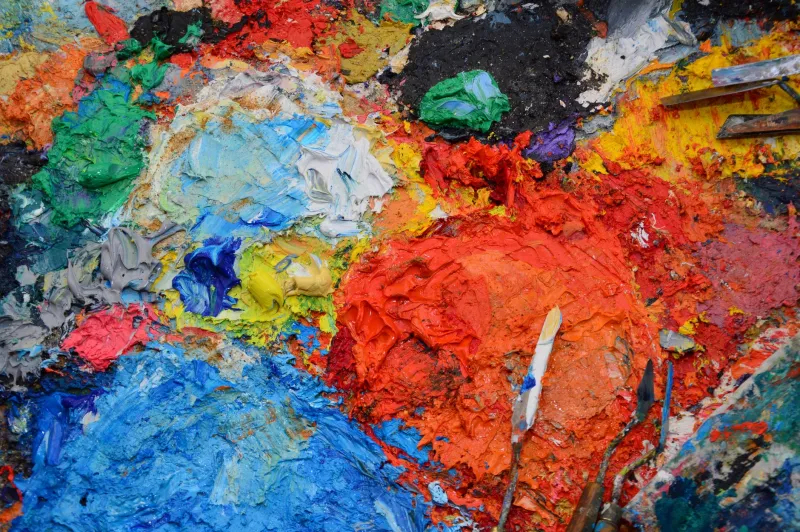
Color decisions that were revised or abandoned. Color relationships in painting are among the most technically demanding and least discussed aspects of practice. An artist's account of a palette that failed—perhaps because it read beautifully in studio light and fell apart under the incandescent warmth of a residential interior—reveals their understanding of how work lives beyond the studio.
-
Compositional structures that were rebuilt mid-process. The ability to recognize that a compositional decision is not serving the work, and to dismantle and rebuild rather than rationalize the flaw, is a hallmark of mature practice. Ask whether the work you are looking at bears any resemblance to its early states.
-
Materials that proved incompatible with the artist's intentions. Every medium has its resistances. An artist who has genuinely pushed against those resistances—and been pushed back—has a richer understanding of what they are working with than one who has always stayed within comfortable parameters.
Reading the Artist's Relationship to Impermanence
There is a secondary layer to this inquiry that collectors rarely reach, and it concerns an artist's relationship to the permanent record of their work. Some artists document their failures meticulously—keeping photographs of abandoned states, maintaining notebooks of color tests that didn't resolve, filing away compositional sketches that were superseded. Others discard everything the moment a direction is abandoned.
Neither approach is inherently superior, but each tells a collector something about how the artist relates to process as distinct from product. The artist who preserves their failures is often one who treats each experiment as data—someone building a cumulative understanding of their own practice over time. The artist who destroys or discards unsuccessful work may be exercising a different kind of discipline: a refusal to allow the process to dilute the authority of the finished piece.
Understanding which orientation an artist holds can inform how a collector thinks about acquiring work across multiple years. The methodical documenter may produce a body of work with visible, traceable evolution—one that rewards the collector who follows it closely. The decisive editor may produce work that appears more singular and self-contained, each piece presenting itself as a resolved statement rather than a chapter in an ongoing inquiry.
What This Means for the Collection Itself
Building a collection around artists who can speak honestly and fluently about their technical failures is not merely an intellectual exercise. It is a practical act of due diligence. An artist who understands why something failed is far less likely to repeat that failure in work that ends up on your walls. An artist who can articulate the material risks they have navigated is one whose finished works carry the authority of earned knowledge, not fortunate accident.
For the discerning collector, this kind of conversation also reframes the relationship between buyer and artist in productive ways. When a collector demonstrates genuine curiosity about the full arc of creative process—including its frustrations and reversals—they signal that they are engaging with the practice, not simply the commodity. That signal tends to foster the kind of long-term artist relationship that serious collectors consistently identify as among the most rewarding dimensions of the pursuit.
The works on the wall represent conclusions. The conversation about what came before them—what was tried, revised, rejected, and finally resolved—is where the real education begins.