Quiet Legacies: Why the Most Rewarding Discoveries Happen Far from the Algorithm
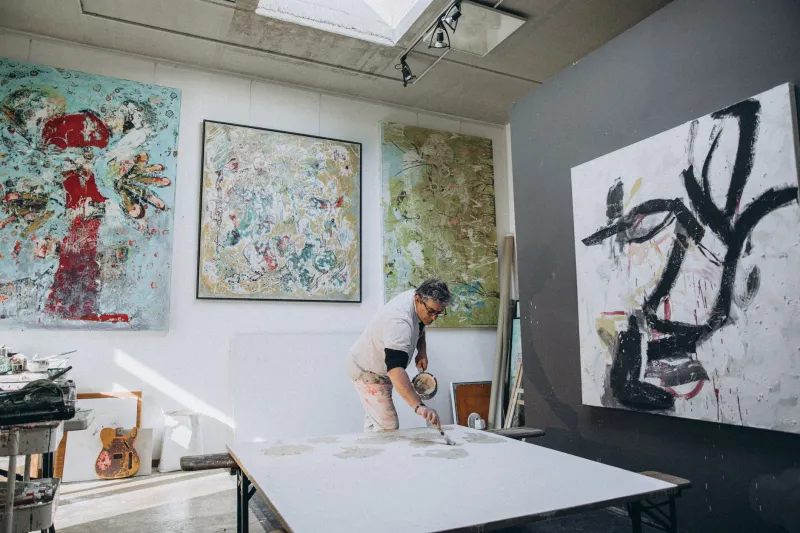
There is a particular kind of artist who accumulates ten thousand Instagram followers in a season: someone who has learned, with considerable skill, how to photograph a painting. The composition is crisp, the lighting flattering, the caption precisely calibrated to inspire the save-button reflex. The work sells. The numbers climb. And yet, five years later, something curious often happens—the market for that artist quietly deflates, while a painter working in relative obscurity, showing at a regional gallery in Marfa or a nonprofit space in Detroit, begins to attract the sustained attention of institutions and serious private collectors alike.
This is not a coincidence. It is, in fact, one of the more reliable patterns in contemporary collecting.
The Metrics Trap
The past decade has transformed how artists reach audiences, and that transformation has introduced a subtle but significant distortion into how collectors evaluate merit. When a work's perceived value is amplified by social proof—likes, reposts, press features generated by influencer adjacency—it becomes genuinely difficult to isolate the intrinsic qualities of the art itself. The noise is too loud.
Engagement metrics measure resonance within a specific digital context, at a specific cultural moment. They do not measure staying power. They do not account for the sustained intellectual or emotional weight that distinguishes a significant work from a decorative one. And they are, by design, optimized for immediacy—the very quality most at odds with the long arc of a meaningful artistic career.
Collectors who have built collections of lasting value tend to describe a different methodology. Rather than beginning with visibility, they begin with questions: Does this work sustain scrutiny over time? Does it reveal new dimensions on the fifth viewing that were invisible on the first? Is the artist's development driven by internal necessity or external appetite?
The Case for Obscurity
Consider the experience of several collectors who now hold works by artists represented in major museum collections—artists they acquired years before institutional recognition arrived. In nearly every case, the initial discovery happened not through a curated feed but through a studio visit, a small group show, a conversation with a gallerist who had been watching quietly. The artists in question were not unknown because their work lacked quality. They were unknown because they had not yet been translated into the visual language that platforms reward.
One collector based in Chicago recalls acquiring a suite of paintings by a then-unrepresented artist she encountered at an open studio event in 2014. The work was dense, demanding, and entirely unsuited to the square-crop format of Instagram. It took years for the broader market to catch up. By the time the artist's first solo museum exhibition opened, the collector had already lived with those paintings long enough to understand them in ways that later buyers—drawn in by reviews and auction results—simply could not.
That depth of relationship, that accumulated intimacy with a body of work, is itself a form of value that cannot be purchased retroactively.
How Serious Collectors Navigate the Noise
The practical question, of course, is how a collector develops the discernment to identify genuine merit outside the channels that have come to dominate discovery. Several approaches recur among experienced collectors.
Engage with the work in person, repeatedly. No screen rendering—regardless of resolution—replicates the experience of standing before an original. Scale, surface, material presence: these are the qualities that determine whether a work endures in a collection or becomes an expensive regret.
Follow curators and critics, not influencers. The individuals paid to think carefully about art—museum curators, independent critics writing for journals with small but serious readerships, residency directors—are often tracking artists long before commercial attention arrives. Their recommendations carry a different weight than algorithmic suggestion.
Attend open studios, regional fairs, and MFA thesis shows. These venues offer access to artists at formative stages, before representation and market pressure have begun to shape their output. The discomfort of encountering work that is still finding itself is, paradoxically, a sign that something genuine is underway.
Be suspicious of rapid ascent. A career that accelerates primarily through social channels, without corresponding institutional engagement or critical discourse, warrants careful scrutiny. Momentum and merit are related concepts that do not always travel together.
The Long View
The artists who will matter in twenty years are almost certainly not the ones generating the most engagement today. History is consistent on this point. The market eventually corrects for noise, and what remains is precisely what was always there: the quality of the work, the coherence of a vision, the evidence of an artist who was building something rather than performing one.
For collectors willing to develop their own eye—to seek out artists whose work demands something of the viewer rather than simply rewarding a glance—the current moment offers a remarkable opportunity. The algorithm, for all its power, has created a kind of shadow market: a vast, undervalued landscape of serious artists whose obscurity is entirely circumstantial.
The collectors who understand this are not waiting for the algorithm to catch up. They are already in the studios.