Silent Partners: How the Collector's Voice Quietly Shapes an Artist's Creative Path
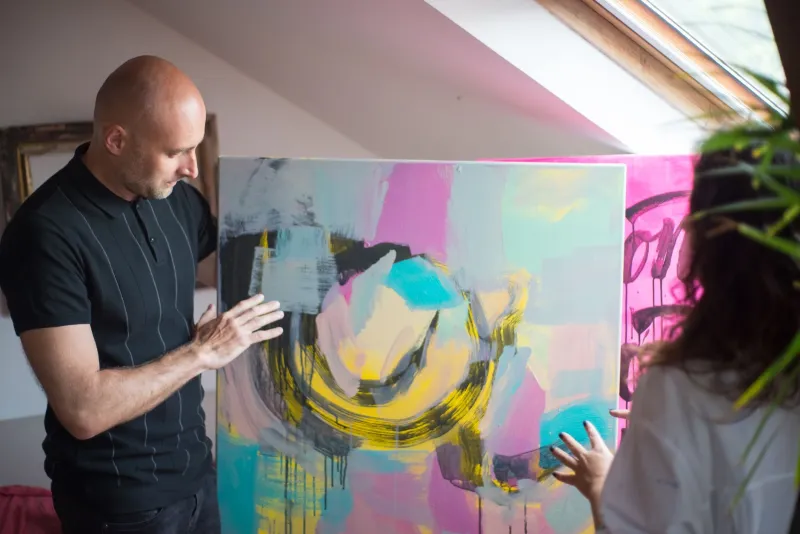
The relationship between a serious collector and a living artist is rarely as one-directional as the transaction suggests. Behind some of the most significant creative breakthroughs in contemporary art lies a quieter force: the sustained, thoughtful engagement of collectors who understood that their role extended well beyond the moment of purchase. These individuals did not simply acquire work and retreat. They asked questions, returned to the studio, and offered observations that, over time, became part of the artist's own internal dialogue.
This phenomenon—largely invisible to the broader art market—deserves careful examination. For collectors who aspire to build collections of lasting consequence, understanding this dynamic is not merely interesting. It is essential.
More Than a Transaction
When a collector purchases a work directly from a living artist, something unusual occurs. Unlike acquiring a piece at auction or through a secondary dealer, the exchange carries with it the possibility of ongoing relationship. The artist remains present, reachable, and—crucially—still evolving. The collector who recognizes this potential and acts on it enters a fundamentally different kind of engagement than one who simply hangs the work and moves on.
Consider what a collector actually brings to the table: a distinct sensibility, an accumulation of visual experience, and a perspective shaped entirely outside the studio. These qualities, when communicated with care and without the transactional pressure of a gallery setting, can illuminate aspects of an artist's work that the artist themselves may not have fully articulated. The collector who notices that a particular series feels emotionally constrained, or that a shift in palette has introduced an unexpected warmth, is offering something that peers, critics, and gallerists often cannot: an honest response from someone who lives with the work.
When Observation Becomes Catalyst
The history of art patronage is dense with examples of collectors whose influence extended beyond financial support into genuine creative collaboration. The Cone sisters of Baltimore, Etta and Claribel, did not simply amass Matisse's work—they maintained a correspondence with the artist that spanned decades, and their responses to individual pieces informed his understanding of how his work was received beyond the European critical establishment. Their American perspective, grounded in a different cultural context, offered Matisse a mirror he could not find elsewhere.
More recently, collectors of contemporary American artists have described studio conversations in which their observations prompted entirely new bodies of work. One prominent collector of figurative painting recounted asking an artist why a recurring architectural element in his canvases was always rendered in shadow. The question was not posed as criticism. It was genuine curiosity. The artist, initially surprised, spent the following weeks working through the answer—and the series that emerged, fully illuminated and structurally exposed, became the most celebrated of his career.
These are not isolated anecdotes. They represent a pattern that emerges consistently when collectors invest not only financially but intellectually in the artists they support.
The Discipline of Thoughtful Observation
Not every observation a collector offers is useful, of course. The distinction between feedback that opens creative doors and commentary that merely imposes personal preference is significant, and serious collectors learn to navigate it carefully. The goal is never to redirect an artist toward one's own taste. It is to reflect back what one genuinely perceives, without agenda, and allow the artist to determine what, if anything, to do with that information.
This requires a degree of self-awareness that not all collectors cultivate. It demands the ability to distinguish between "I would prefer this differently" and "I notice something here that seems unresolved." The former is a matter of personal preference; the latter is an observation that may carry genuine creative weight. Collectors who develop this discipline become interlocutors of real value—people whose visits to the studio an artist anticipates rather than merely tolerates.
Long-term patronage amplifies this dynamic considerably. A collector who has followed an artist's work across five, ten, or fifteen years possesses a longitudinal understanding of that practice that is nearly impossible to replicate. They can identify when an artist is circling a problem they have encountered before, when a new direction represents genuine evolution rather than stylistic restlessness, and when the work is operating at a level the artist may not yet fully recognize. This accumulated knowledge, shared openly and without possessiveness, is among the most valuable contributions a collector can make.
Patronage as Active Participation
The American tradition of private art patronage has always contained within it the possibility of something more substantive than financial exchange. From the early twentieth-century salons of Mabel Dodge Luhan, whose gatherings in New York and Taos brought artists into sustained dialogue with thinkers, writers, and collectors, to the intimate studio relationships that define the contemporary gallery landscape, serious collectors have repeatedly demonstrated that their engagement shapes not only what art gets made but what art becomes possible.
This is not a responsibility to be taken lightly. An artist in the midst of developing a new body of work is, in certain respects, vulnerable. The collector who enters that space brings influence whether they intend to or not. The question is whether that influence is exercised with care, with genuine curiosity, and with respect for the artist's ultimate authority over their own practice.
When those conditions are met, the results can be extraordinary. Artists describe these relationships as among the most generative of their careers—not because the collector told them what to do, but because the quality of attention they received clarified something they had been unable to see on their own.
What This Means for the Discerning Collector
For those who approach collecting as a serious pursuit rather than a decorative exercise, the implications of this dynamic are worth sitting with. The works that define the finest collections are rarely accidental acquisitions. They are the result of sustained attention, cultivated relationships, and a willingness to engage with living artists as the complex, evolving practitioners they are.
A collection built in this spirit carries something that no secondary-market acquisition can replicate: a thread of genuine dialogue woven into its history. The collector who asks the right question at the right moment, who visits the studio not once but repeatedly, and who offers their honest perception without attempting to own the artist's direction—that collector becomes, quietly and without fanfare, part of the work itself.
That is a form of legacy worth pursuing.